
Bookkeeping
Accounts Payable Vs Trade Payable: Differences & Similarities
All supplier invoices are immediately routed to the payables department as soon as they are received. This can be a difficult processing step, since Liability Accounts invoices might have been sent to the person authorizing a purchase, or perhaps to a subsidiary. In either case, there must be a firm requirement for the recipient to immediately forward the invoice to the payables department. A particular concern is when invoices are sent to people who no longer work for the company – perhaps by email; if so, it may take repeated inquiries from the supplier before the invoice is found. The careful management of these balances not only impacts cash flow and profitability but also affects supplier relationships, operational efficiency and overall financial health.
Step 1. Historical A/P Days Calculation Example

Stay connected with cutting-edge procurement and supply chain insights – anytime, anywhere. By checking Accounting Periods and Methods the box below, you consent to GEP using your personal information to send you thought leadership content – such as white papers, research reports, case studies – and other communications. GEP representatives may contact you to provide additional information or answer questions.
Example of Trade Payables vs. Accounts Payable
- It’s important to note that since 2007, foreign corporations with US registrations don’t need to reconcile their financial reports according to GAAP if they already adhere to IFRS.
- Occasionally an individual will provide services for a company and submits an invoice.
- Accounts payable can be categorized into trade payables, non-trade payables, and taxes payable.
- Accounts Payable organizes and maintains vendor contact information, payment terms, and Internal Revenue Service W-9 information either manually or using a computer database.
- Run an aging analysis – Review a report that groups invoices by due date (e.g., current, 30 days past due, 60 days past due).
- It allows you to determine which period to apply the related payables and whether it belongs to the previous one.
GAAP, or Generally Accepted Accounting Principles, is a set of accounting standards and guidelines used in the United States to prepare and present financial statements. Publicly traded companies must comply with it, while private companies may follow it to improve their credibility. Nevertheless, tailoring GAAP to a specific industry is a time-consuming process.
#3 – Enhances Financial Reporting and Planning
Consistent and timely payments improve a company’s credit rating, which can lead to more favorable credit terms and lower interest rates when borrowing. Though they both have similarities in their function—everyday operational expenses, they are subtly different. All trade payables are accounts payable, but not all accounts payables are trade payables. We know that maintaining strong financial management is essential for success. And two important components of this are trade accounts payables and trade receivables.

How Does this Ratio Relate to the Cash Conversion Cycle?
- In financial modeling, the accounts payable turnover ratio (or turnover days) is an important assumption for creating the balance sheet forecast.
- In their accounting, bulk beans are categorized as cost of goods while individual bags are categorized as inventory.
- Nevertheless, tailoring GAAP to a specific industry is a time-consuming process.
- Accounts payables are the credit nature class shown under the current liabilities section of the statement of financial position.
Small expenses such as miscellaneous postage, out-of-pocket office supplies or company meeting lunch are handled as petty cash. AP often handles a supply of sales tax exemption certificates issued to managers to ensure qualifying business purchases don’t include sales tax expenses. Depending on the responsibilities accounts payable receives from a company, they might process requests and distribute funds to cover travel expenses. After business travel, AP would then be responsible for settling funds distributed versus funds spent and processing travel reimbursement requests.
- As such, accounts payable is a liability account; it is not a business expense.
- An efficient company may have small to specific large balances of trade payables.
- Specifically, trade payable includes only the purchase of any costs of fulfillment like inventory or manufacturing materials on credit.
- No, a trade payable is the liability recorded by the business for an unpaid invoice.
- The record of what that company owes its supplier is called trade payables.
- By purchasing on credit, businesses can preserve cash flow while obtaining the resources they need to operate.
- The auditor should ensure that accounts payable transactions are recorded in compliance with Generally Accepted Accounting Principle (GAAP).
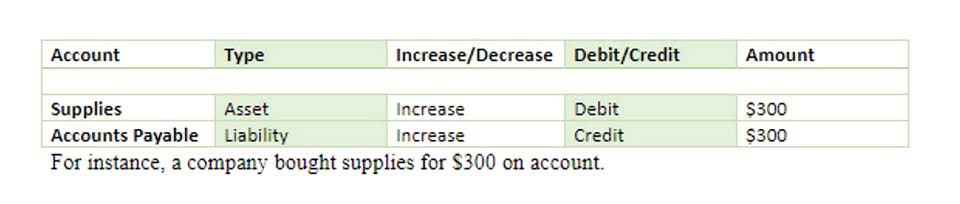
Because it’s not exhausted in the production of their goods, the machine is categorized as accounts payable. The shop notates the invoice to make it clear what should be bucketed where. The coffee shop already knows that bulk beans and paper cups are treated as trade payable. trade payables But if there’s a financing structure, like a loan or payment plan with interest, it’s no longer considered accounts payable. You get to choose when the money goes out, giving you the flexibility to pay when you have cash on hand—so long as it aligns with your payment terms. Buying things on credit gives businesses an opportunity to take control of their cash flow.
